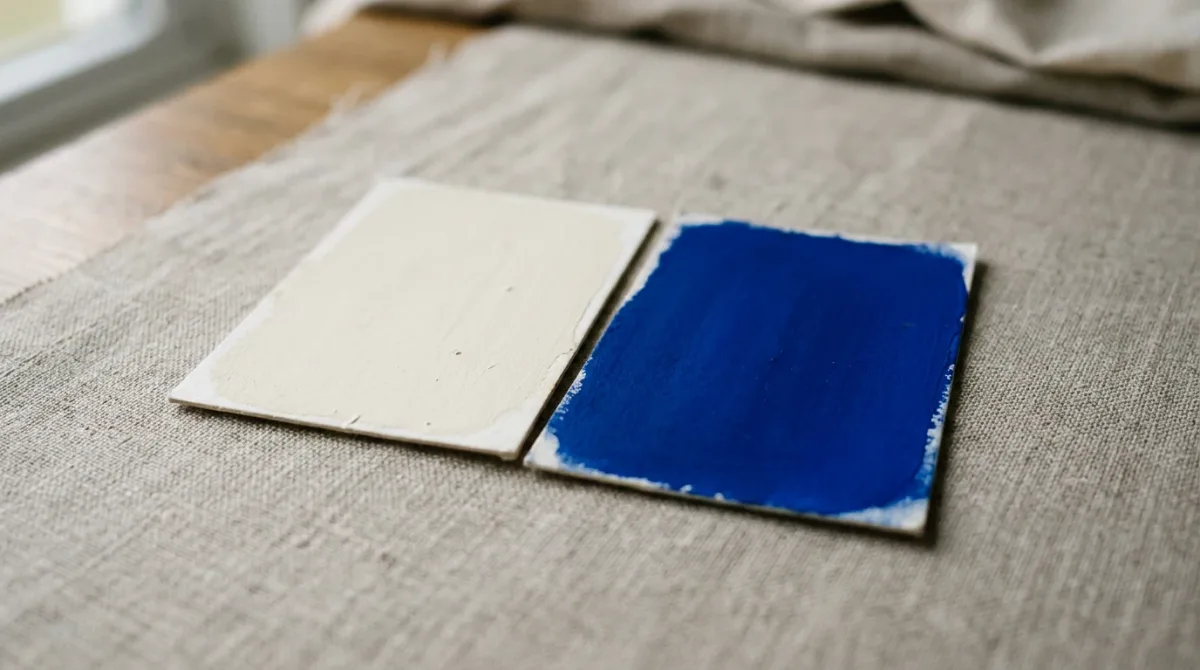
Two different organizations can name two different colors for two different years without either one being wrong: Pantone named Cloud Dancer, a soft white, its Color of the Year for 2026, while WGSN and Coloro named Luminous Blue their Colour of the Year for 2027, unveiled in April 2025, nearly two years ahead of the season it covers. The gap is not a disagreement so much as two forecasting methods running on different clocks and different inputs, one built on cultural observation, the other on data and material feasibility testing.
What does naming a "color of the year" actually mean?
It means a named organization has committed, in public, to one shade it expects to define the coming period in design, retail, and product development. Pantone, through its Pantone Color Institute, frames the choice as a cultural signal rather than a command. Pantone's own announcement quotes Executive Director Leatrice Eiseman describing Cloud Dancer as "a conscious statement of simplification" that "enhances our focus, providing release from the distraction of external influences," and Vice President Laurie Pressman saying the shade "exemplifies our search for balance between our digital future and our primal need for human connection."
WGSN and Coloro, the color-forecasting partnership that names its own Colour of the Year, describe a different kind of authority: not a cultural mood read but a system. Clare Smith, WGSN's senior color strategist, called Luminous Blue a hue with "a dynamic quality" that is "both mysterious and eccentric, with versatility and a broad appeal that will resonate from occasionwear to active," according to the companies' joint announcement.
Neither organization is naming an isolated fact. Pantone's Fashionista-reported predecessor for 2025, Mocha Mousse, shows the annual naming is a running series, not a one-off, and NPR's reporting notes there is evidence that a Pantone-named shade does tend to increase in popularity afterward, even as Pressman stresses the program's goal is understanding color's influence rather than dictating a single must-buy hue.
How does each organization actually pick its color?
Pantone does not publish a fixed methodology, and reporting on the process describes it as deliberately opaque. NPR, reporting on the 2026 selection, found there is no single decision-making meeting; instead, members of the Pantone Color Institute, who come from varied professional backgrounds, work year-round observing design and culture, in a process one source described to NPR as resembling "a high-concept show-and-tell fused with a cultural anthropology seminar." Pressman told NPR the program's purpose is to help companies and consumers understand color's power, not to promote a specific shade for its own sake.
WGSN and Coloro run a more structured pipeline. According to their joint press release, WGSN's color experts select candidate hues directly from Coloro's library of more than 3,500 colors, and Coloro then runs the chosen shade through its Feasibility Intelligence tool, which performs "health checks" to confirm the color is achievable across different materials before it is released to the industry. WGSN has also said its broader trend insights carry a claimed accuracy rate of 93 percent, a figure the company attributes to its own forecasting record, as reported by Fashionista.
Do the two colors on the calendar right now agree with each other?
Not exactly, and the site reports that as a genuine split rather than resolving it into a single verdict. The two calls cover different horizons: Cloud Dancer is Pantone's headline color for calendar year 2026, while Luminous Blue is WGSN and Coloro's headline color for 2027, released well ahead of its season the way the pair has done since at least the 2025 cycle, per Fashionista's reporting. A quiet, minimal white and a saturated, high-visibility blue are not merely different colors; they represent different bets about what buyers will want to feel next — restraint against digital noise, in Pantone's case, versus what WGSN and Coloro describe as 2027's broader theme of "interconnectedness" between opposing moods.
| Forecaster | Named color | Horizon | Stated rationale |
|---|---|---|---|
| Pantone Color Institute | Cloud Dancer (PANTONE 11-4201) | Calendar year 2026 | Cultural desire for calm and simplification, per Eiseman and Pressman |
| WGSN & Coloro | Luminous Blue | Spring/Summer 2027 | Versatility and "interconnectedness" across consumer moods, per Smith |
What happens to a color once it has the title?
The name is the start of a licensing and production cycle, not the end of one. WGSN and Coloro's release names Luminous Blue as the lead of a five-color Spring/Summer 2027 palette that also includes Energy Orange, Pop Pink, Meadowland Green, and Clay — a set meant to give buyers and manufacturers a coordinated starting point long before fabric goes into production. Pantone, for its part, pairs its Color of the Year with retail and home products carrying the shade, extending Cloud Dancer's reach into paint, textiles, and consumer goods beyond apparel. Whether either color shows up on runways or shop floors in the volume the forecasters expect is a separate, later question the trade press tracks each season — this piece covers only how the naming happens, not whether the industry follows.
Why does the timing gap between the two announcements matter?
Pantone typically reveals its Color of the Year at the close of the preceding calendar year — the 2026 pick, Cloud Dancer, arrived in Pantone's own December announcement cycle, per NPR's reporting, meaning brands and consumers meet it only weeks before the year it names begins. WGSN and Coloro work on a longer lead: Fashionista reported that Luminous Blue was unveiled on April 29, 2025, nearly two full years ahead of the Spring/Summer 2027 season it targets.
That gap is not incidental; it reflects who each forecast is built for. Pantone's shorter runway suits a broad audience of consumers, designers, and brands who respond quickly across categories from apparel to home goods. WGSN and Coloro's two-year runway is built for the supply side of the fashion industry, where a color has to clear Coloro's material feasibility checks and then move through dye development, fabric sourcing, and sample production long before a Spring/Summer 2027 garment reaches a store. A forecast aimed at manufacturing has to be named while there is still time to manufacture around it.
Why do the two systems disagree on how much to show their work?
Because they are selling different things. Pantone's opacity is arguably part of its brand: a color chosen by a small group reading culture, not an algorithm, is easier to frame as intuition earned over decades. WGSN and Coloro's structured pipeline, with a specific color library size and a named feasibility tool, is built for buyers who need a defensible, repeatable process before committing production budgets to a shade. WGSN's claimed 93 percent accuracy figure, reported by Fashionista, illustrates the same split in emphasis: it is a number meant to reassure buyers the system works, in a category where no forecaster's hit rate is independently audited by an outside body. Neither approach is presented by its own organization as a guarantee; both are forecasts, named and dated, about what is expected to matter next.
For a related lifestyle perspective, read How a Season's Color Gets Named, Two Years in Advance.
For more context, read How Cloud Dancer Became Pantone's Color for 2026.
For more context, read How a Color Becomes the Season: Cloud Dancer, Explained.
For more context, read Fashion Trends: Fashion and Trends.