Lifestyle medicine is a simple idea: the daily habits around food, movement, sleep, stress and connection shape long-term health more than most people assume. The catch is that the habits only work if they last. Most attempts fail not because the habits are wrong, but because people try to install all of them at once, in January, on a schedule their real life cannot hold.
This guide walks through the core pillars of lifestyle medicine and a slower way to adopt them. The goal is not a perfect routine. It is a small set of habits that survive busy weeks, bad nights and ordinary motivation.
What is lifestyle medicine, in plain terms?
Lifestyle medicine is the practice of preventing and managing health problems by changing daily behavior rather than reaching first for prescriptions. The behaviors it works with are familiar: what you eat, how much you move, how you sleep, how you handle stress, and how much time you spend with other people. None of this is exotic. It is the unglamorous work of ordinary days.
The framing matters. As Helpful Professor puts it, a lifestyle is a "way of life" — the habits, rituals and behaviors that make up a person's daily activities. Lifestyle medicine simply aims that way of life at health on purpose. A healthy lifestyle, in the same source's summary, centers on habits that promote health and prevent disease: a nourishing diet, regular exercise, and skipping harmful behaviors, with mental health and stress management named as vital components too.
That definition is worth pausing on. It does not require a gym membership, a supplement stack or a retreat. It asks for a pattern — repeated, ordinary choices — which is exactly why the pattern is the hard part.
What are the core pillars of lifestyle medicine?
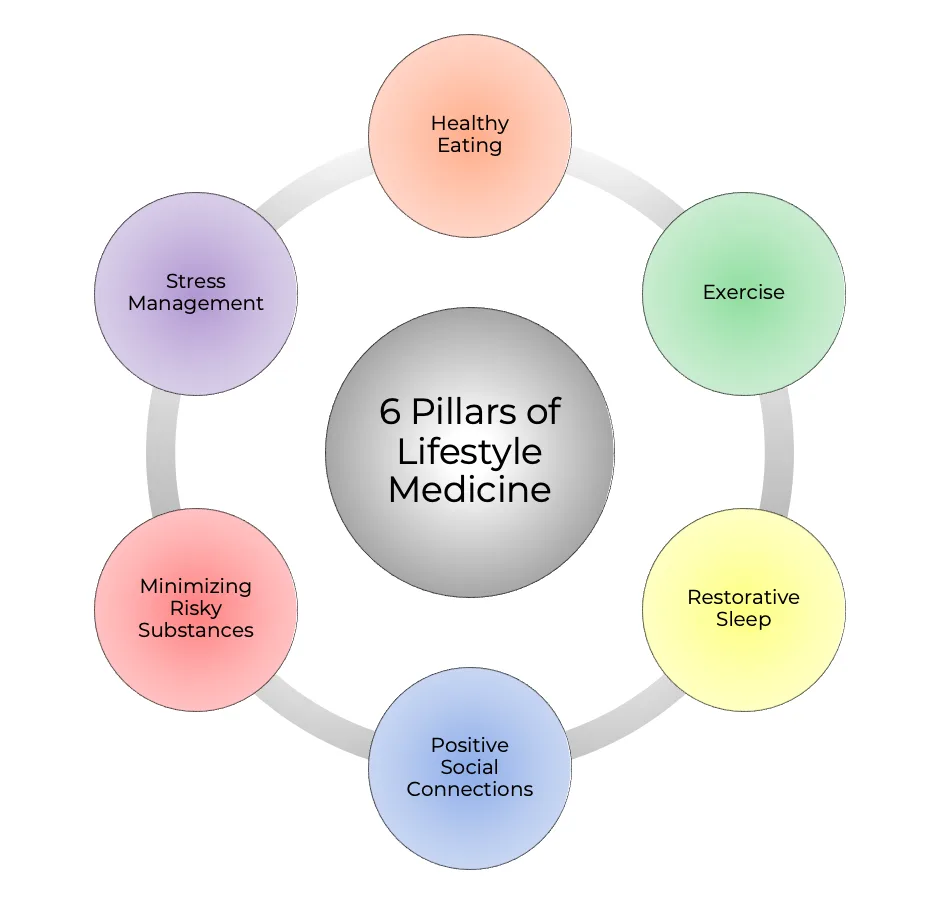
Practitioners in this field tend to organize their work around a small set of pillars. The exact wording varies by clinic and country, but the substance is consistent across the field. The pillars are usually described as:
- Whole, mostly plant-based eating — building meals around vegetables, fruit, legumes and whole grains rather than around restriction.
- Regular physical activity — movement woven into the week, whether structured exercise or activity folded into daily tasks, which the Helpful Professor summary describes as the active lifestyle that can carry significant health benefits.
- Restorative sleep — a consistent window for bed and wake time, protected like any other commitment.
- Stress management — deliberate practices that lower the load, from breathing exercises to time outdoors.
- Positive social connection — relationships treated as a health input, not a luxury.
- Avoiding harmful substances — the abstaining-from-harmful-behaviors piece the source summary names directly.
Notice what the list has in common: every item is behavioral. That is the promise and the problem. Pills get taken once a day. Habits have to be chosen hundreds of times.
Why do these habits fail so often?
The failure pattern is predictable, and it is not a character flaw. Most people launch all six pillars in the same week, usually after a holiday or a health scare. The plan assumes a schedule, an energy level and a mood that no real week contains. When the plan breaks on Tuesday, the whole project feels broken.
There is also a novelty problem. A habit built on enthusiasm has a short life, because enthusiasm fades on schedule. A habit built on structure — the same breakfast, the same walk after lunch, the same lights-out time — does not need enthusiasm to run. This is the same logic behind a morning routine that survives real schedules rather than fantasy ones; the routine has to fit the life you actually have. Readers following this should also see A Morning Routine That Survives Real Schedules, Not Fantasy Ones.
Perfection is the third culprit. Lifestyle medicine asks for direction, not purity. A person who eats well four days out of seven, every week, for years, is doing the work. A person who eats perfectly for eleven days and then quits has done almost nothing durable. The all-or-nothing frame quietly destroys more healthy lifestyles than any cheeseburger.
How do you start without burning out?
The reliable path is gradual, almost boringly so. Start smaller than feels meaningful, attach new habits to existing ones, and let each one settle before adding the next. A workable sequence:
- Pick one pillar. Movement is often the easiest first choice, because a walk needs no equipment, planning or willpower beyond the first few minutes.
- Make it tiny. Ten minutes after lunch, every weekday. The size should feel almost too easy; that is what makes it repeatable.
- Anchor it. Attach the new habit to something that already happens without thinking — lunch ends, the walk starts. Anchored habits need less memory and less motivation.
- Hold for two to four weeks. Let the habit become unremarkable before you add anything. Boring is the goal.
- Add the next pillar. Sleep is a strong second choice, because better nights make every other habit easier to keep.
- Track lightly. A tick on a calendar, nothing more. The point is evidence to yourself, not a scorecard.
What this means in practice: by the end of a season, you can have two or three pillars running on structure alone. By the end of a year, the pattern looks like the lifestyle the source describes — and it holds because it was never built on a burst of motivation in the first place.
Which pillar should you build first?
There is no universal answer, but there are useful rules of thumb. If your sleep is badly broken, start there; short nights quietly tax every other habit, from food choices to patience. If sleep is roughly fine, movement is usually the highest-leverage starting point, because it improves mood, stress and appetite regulation as side effects of showing up.
Food changes work best when they start as additions rather than subtractions: one extra vegetable at dinner, beans in the weekly rotation, water before the second coffee. Subtraction-only plans feel like punishment, and punishment schedules quit. Connection, the most overlooked pillar, can start as simply as one standing commitment — a weekly call, a walk with a neighbor — that no cancellation can move.
Our analysis across the lifestyle coverage on this site keeps landing on the same principle: the habits that last are the ones that fit a real week. That is true for how people curate a home that reflects their style, and it is true for health. A habit that requires your best day will not survive your average one.
Where lifestyle medicine fits a fuller life
It helps to see these habits as part of a broader way of living rather than a medical program bolted onto your week. The slow-living approach — savoring the present, reducing stress, choosing quality over quantity — overlaps with the stress-management and connection pillars almost exactly. Readers who want that wider frame can start with our guide to Slow Living: What It Means and How to Start, or browse the rest of our lifestyle coverage.
The honest close: lifestyle medicine asks for direction, not perfection, and not speed. Build one small habit, anchor it, and let it become the kind of thing you do without deciding. The evidence-based pillars are well known. What separates the people who benefit from them is rarely knowledge. It is the patience to build slowly and the good sense to stop relying on motivation.