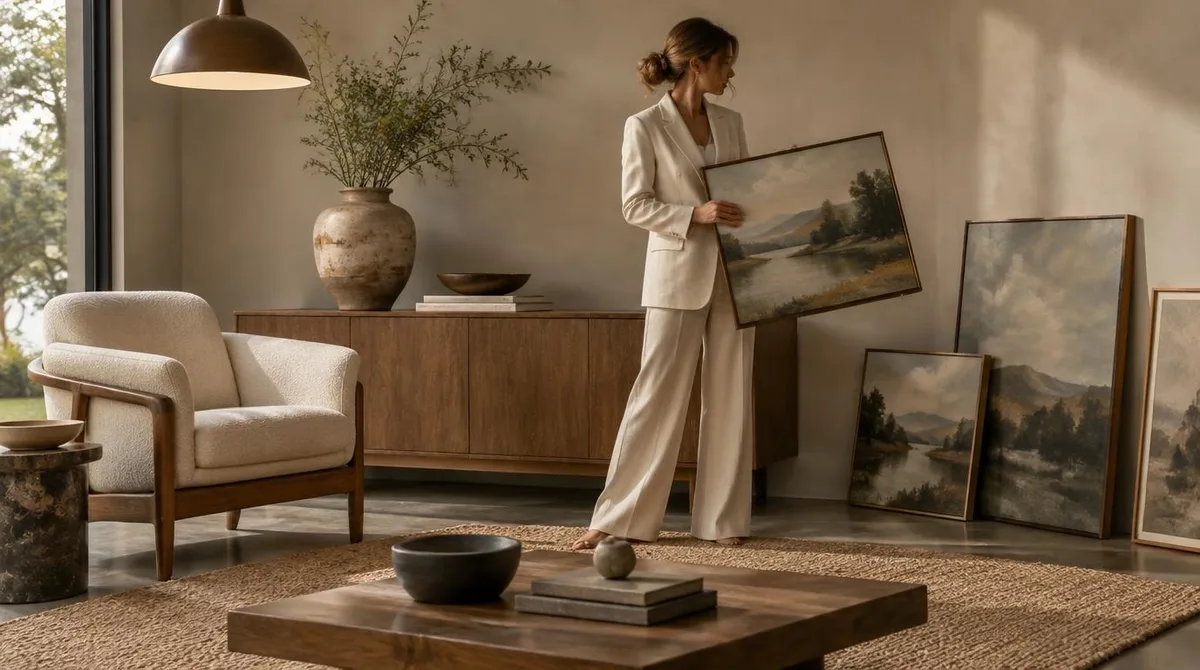
A home that reflects your style is not bought in one afternoon. It is assembled, piece by piece, the way a gallery assembles a show: something is chosen, something is left out, and the selection is arranged with care. That is what the word "curate" actually asks of you, and it is the difference between a room that feels like you and a room that feels like a checklist.
The good news is that the work is mostly editing, not spending. Before buying anything new, decide what the room is for, keep what already earns its place, and add only what fills a real gap. The rest — the trend pieces, the filler, the things bought because a feed said so — can wait, or never arrive at all.
What does "curate" actually mean for a home?
The word gets used loosely, but it has a real definition. As Dictionary.com defines it, to curate is to "pull together, sift through, and select for presentation" — originally the work of a museum or exhibition organizer, now applied to everything from playlists to merchandise. A second usage reference, English Word Champs, stresses the same two parts: selection and thoughtful arrangement, not random picking.
Applied to a room, that means two jobs. First, sift: decide what belongs and what does not. Second, arrange: place what remains so it reads as a deliberate whole. Neither job requires a budget. Both require patience, which is why a curated home tends to come together over months rather than a weekend.
The museum analogy is more useful than it sounds. A curator does not display everything in the archive. The strength of an exhibition comes from what stays in storage. Your spare room, your cupboards, and the box in the closet are your storage, and using them well is the whole discipline.
Where do you start when nothing in the room feels like you?
Start with what you already own, before any shopping. Walk the room and sort everything into three groups: keep, unsure, and out. The keep pile should hold only things you would buy again today. The unsure pile gets boxed and dated — if you have not missed an item after a season, it has answered its own question.
Then look at the keep pile as a collection rather than clutter. Note what repeats: a color, a material, a mood. That repetition is your style showing itself, and it is more reliable evidence than any saved photo folder. Most people discover their taste is narrower and more consistent than they assumed.
Only after the sort do you write the actual list of gaps: a lamp that lights the reading chair, one more seat for guests, a rug that quiets the echo. A list built this way stays short, because it describes function first and decoration second.
How do you keep trend pressure out of your rooms?
Trend pressure is real, and it moves fast. The same cycle that reshapes wardrobes and restaurants now shapes interiors, as The Trend Mag has covered in its piece on the Food Trend Cycle: Why Food Trends Now Move Like Fashion Trends. When everything cycles quickly, the defense is not to ignore trends but to price them correctly: as short-term accents, never as the room's foundation.
The test is simple. Would you want this piece if nobody were talking about it? If the honest answer is no, it is a rental of a mood, not a purchase. Small, swappable items — a cushion, a throw, a print — can carry a trend. A sofa, a floor tile, or a kitchen scheme cannot, because you will live with the decision long after the conversation has moved on.
Our analysis of what makes a purchase durable comes down to one question: does the item serve the room's job, or only the season's mood? The same reasoning The Trend Mag laid out in What Makes A Trend Worth Your Money applies to a home: spend on the things you touch every day, and treat the loud, cheap, and fashionable as disposable by design.
It also helps to recognize a microtrend before it reaches your cart. The signs — sudden everywhere-ness, a single viral object, a price that only makes sense as a fad — are the ones described in How To Spot A Microtrend Before You Buy. Naming the pattern is often enough to slow the purchase down.
What does a curated room actually look like?
It looks quieter than a styled photo, and it works harder. A few markers recur in rooms that hold up:
- One idea per room. A single organizing thought — warm woods, a family of blues, a love of ceramics — ties the space together. Two or three competing ideas read as noise.
- Anchor pieces that earn their keep. The sofa, the table, the bed. These carry the room and should be the least trendy things in it.
- Room to breathe. Negative space is part of the arrangement. A wall with one good print says more than a wall with nine.
- Objects with a reason. Every surface item answers the question "why is this here?" Souvenirs, gifts, and inherited pieces count — but they count as choices, not defaults.
None of this means sterile. Personality comes from the specific and slightly odd: the portrait from a flea market, the chipped bowl you refuse to replace, the chair in the wrong color that you love anyway. Curating is not minimizing. It is choosing.
How do you build the habit without burning out?
Treat it as maintenance, not a project. A slow, steady rhythm — one shelf this month, one corner next — fits the pace recommended in Slow Living: What It Means and How to Start, and it suits a home better than a dramatic purge you regret in a week. More on the broader approach lives in the Lifestyle section.
- Set the job of the room. Sleep, gather, cook, work. Every later decision answers to this.
- Edit before you buy. Remove what fails the keep test. The gaps become obvious only after the edit.
- Write a short list of gaps. Function first. Keep it to a handful of items.
- Buy slowly, secondhand first. Waiting for the right piece is part of curating, not a delay in it.
- Arrange, then live with it. Adjust after a week of real use, not a photo.
One more habit helps: keep a simple note of pieces you are hunting for, with rough dimensions. Impulse purchases shrink when the shopping has a script.
What this means for your home
Curating a home is a slower path to a better result. The evidence for the word itself — selection plus thoughtful arrangement, per the definitions cited above — points to patience as the method, not a budget. Rooms assembled this way change less and satisfy longer, because every object in them was chosen against a real standard: does it serve the room, and do you still want it?
What remains unknown is only the timeline, and that belongs to you. Some rooms come together in a season; some take years of collecting. Both are correct. The measure is not how fast the room was finished, but whether, standing in it, you can point to each thing and say why it stayed.