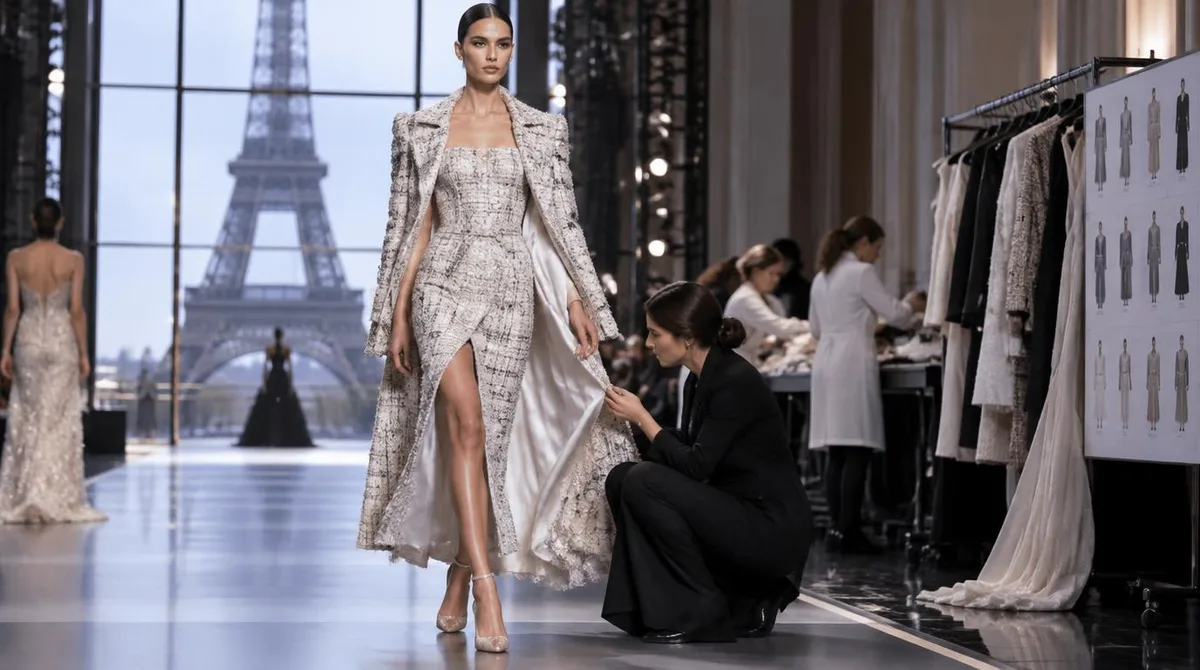
The fashion show season — the month-long runway circuit that runs through New York, London, Milan and Paris twice a year — is the industry's main commercial calendar. Designers show upcoming collections to buyers, press and stylists months before the clothes reach stores. The cities are recognised as the world's three leading fashion capitals, New York, Paris and Milan, with London close behind; Wikipedia's overview of fashion notes they headquarter the most significant fashion companies and hold the greatest influence over global style.
Each city signals something different. New York opens with American commercial sportswear. London carries the experimental and the newly graduated. Milan is the home of the Italian luxury houses. Paris closes with the biggest names and, traditionally, the most-watched debuts. Reading the schedule as a sequence, rather than a list, explains why a designer's choice of city is itself a statement.
The rhythm matters commercially as well. A misread season shows up later in markdown rates, a link this publication has traced in detail in Why Markdown Rates Reveal a Misread Season. The runway is where that bet is placed in public.
What is the fashion week schedule, and who runs it?
A fashion week is an organised run of designer shows, presentations and appointments held in a single city over several days. Each is coordinated by a local governing body or chamber that sets the official calendar, admits designers to the schedule and handles venue logistics. Designers not on the official calendar show off-schedule, in showrooms, apartments or unlisted venues — a parallel programme that has historically produced some of the circuit's most talked-about work.
Showing on the official schedule carries weight. It signals a house's standing to buyers deciding what to stock, and to editors deciding what to cover. The calendar itself has become news: this publication covered how the autumn 2026 fashion calendar tightened until the schedule itself became the story, with compressed windows changing how much attention each show could hold.
Why do the four cities show in this order?
The New York–London–Milan–Paris sequence is partly tradition, partly logic. New York, the most commercially oriented market, opens. London follows with its younger, more experimental roster. Milan then hands over to the Italian houses, and Paris closes with the largest concentration of global luxury brands — the finale position the biggest houses have long held. Wikipedia's fashion overview identifies New York, Paris and Milan as the recognised leading capitals, with Tokyo, London and Los Angeles often described as second-tier centers in some fashion circles.
The order also serves the trade. Buyers travel the circuit in one direction, reviewing collections city by city, then place orders. Press follows the same route. A designer showing off-sequence, or between the majors, risks the audience having already flown home.
What does each city's shows actually signal?
New York signals the state of the American commercial market: accessible luxury, sportswear heritage and department-store economics. A strong New York week usually means the American retail machine is confident.
London signals direction rather than volume. Its schedule is weighted toward emerging designers and art-school graduates, so what surfaces there often reaches the high street two or three years later. Milan signals the health of the Italian supply chain — leather goods, knitwear, tailoring — and the stability of houses such as those showing there each season. Paris signals power. It is where the global luxury groups stage their biggest statements, and where creative-director debuts draw the widest attention, as with the season this publication framed in Three Debuts Make February 2026 the Season to Watch.
One concrete example of how Paris closes the month with the loudest read: Hello! Fashion rounded up the standout trends from Paris Fashion Week spring/summer 2027 — from top-to-toe gold to bruised hues — noting the City of Light as the last stop on a whirlwind fashion month. The coverage treated Paris as the summary session of the whole season, which is exactly how the industry reads it.
Who attends, and why does the front row matter commercially?
The audience divides into four groups, each doing a different job. Buyers from department stores and boutiques write the orders that turn a runway look into inventory. Editors and critics set the coverage that shapes demand. Stylists pull pieces for shoots and red carpets, giving collections a second life in imagery. And celebrities — whose presence now generates much of the mainstream attention — lend houses reach far beyond the trade.
The celebrity layer has grown heavy enough to distort the read. ELLE's fashion coverage of the recent season tracked front-row figures from Rihanna to Kate Moss at Paris alongside its runway trend reports, and its street-style coverage of Milan was framed as "setting the tone" for spring/summer 2027 — the guests, in other words, now carry as much signal as the clothes. Editors reading a season have to separate the two.
Behind the scenes, the shows connect to the wider trade calendar. Fabrics and materials are actually decided months earlier at trade fairs, a process this publication explained in Fashion Trade Shows Explained: Where Next Season's Fabrics Are Actually Decided. The runway is the endpoint of a supply decision, not the start of one.
How do the shows connect to what you wear later?
The gap between runway and retail is roughly six months: a spring/summer collection shows in the autumn, and lands in stores near the start of the season it is named for. In between, the signals travel through several filters — trend agencies distil the season into direction, retailers choose which looks to buy into, and press decides which ideas deserve language. This publication's forecasting coverage follows that translation chain, including how agencies such as WGSN built a business turning runway signals into product decisions.
Not every runway idea survives the trip. What typically reaches the high street is the palette, the proportion and the mood — the purple colourways and fringed skirts that Hello! Fashion flagged across the recent fashion month — rather than the exact garment. The extreme looks function as advertising for the wearable ones.
What this means for a reader: treat the schedule as a season-long argument rather than a series of parties. New York states the commercial case, London proposes, Milan produces, and Paris rules. The clothes you will actually be able to buy are the ones all four cities quietly agree on.
The takeaway on fashion show season
Fashion show season is the industry's twice-yearly decision cycle, staged in public. Who shows, where, and in what order encodes the commercial hierarchy of fashion — which cities hold power, which houses can afford the stage, and which ideas the trade is willing to bet inventory on. The spectacle is real, but the schedule underneath it is the more honest document. Read the calendar first; the clothes will tell you the rest.