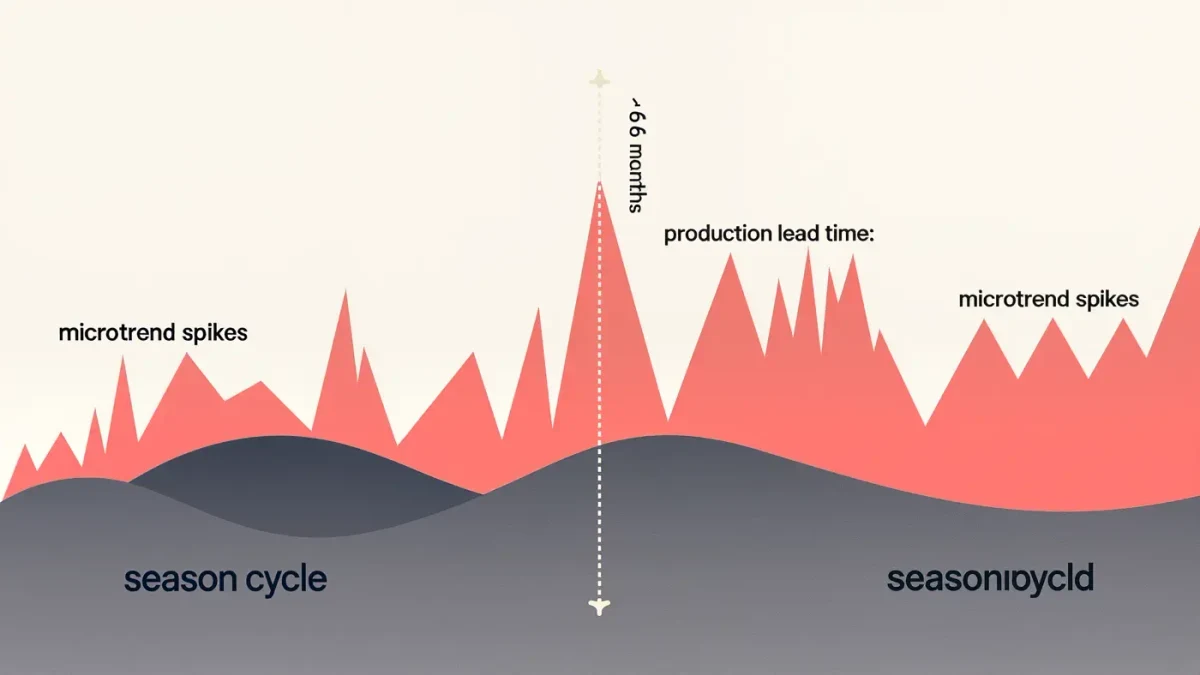
Microtrends — aesthetic waves that rise and fall in weeks rather than seasons — have cut the fashion cycle from two decades' standard cadence to something closer to a news cycle. A named mood can go from a creator's video to mass-market product to ironic punchline inside a single quarter; the coastal grandmother look of 2022, the tomato girl summer of 2023, and the mob wife aesthetic that peaked in early 2025 each followed that arc, as fashion press and platform analysts documented in near real time. The traditional calendar — two seasons a year, directions set months ahead — still governs production, but it no longer governs attention.
That split is the real change: a growing gap between how fast culture moves and how fast clothing can be made, with every part of the industry — forecasters, brands, retailers, and the Wardrobe itself — forced to choose which clock it lives on.
What exactly is a microtrend?
A short, named, content-native aesthetic: not a silhouette or a color system, but a bundled vibe — specific pieces, a palette, a soundtrack, a fictional persona — that platforms can iterate and audiences can try on overnight. The structure matters. Traditional trends diffused through magazines and runway coverage over months and were anchored to products a consumer could buy for years. Microtrends diffuse through feeds in days, attach to cheap, immediately purchasable items, and burn out when the platform's attention moves on — often within a season, sometimes within weeks.
Their economics are distinctive too. A microtrend is a demand spike with a steep tail-off, which rewards whoever can produce fastest and penalizes anyone holding inventory after the peak — the opposite of the two-season bet the wholesale system is built to place.
What happens inside a microtrend's short life?
A predictable sequence, compressed. It begins with a naming moment — a video, a caption, a tag that gives an inchoate look a handle. Then discovery: the feed amplifies, early adopters assemble shopping lists, and search volume spikes. Monetization follows within days, as fast retailers list adjacent product and creators link it. Saturation arrives when the aesthetic is recognizable enough for brand accounts to reference it — the signal to insiders that the moment is over. Decline takes the form of irony: parody videos, thrift-flipping, and think pieces about the trend's death, which double as its obituary and its archive.
The entire arc once described a full fashion era. Watching one complete inside a quarter taught the industry how much of the old cycle was simply distribution delay — and how little of it was actually necessary.
How did the cycle accelerate this far?
Through three compounding changes. Platform dynamics: recommendation feeds reward novelty, so content that names a new aesthetic outperforms content that documents an existing one, manufacturing the appearance — and then the reality — of constant change. Production capacity: decades of fast fashion built supply chains that can answer a spike in weeks, something the 2010s infrastructure could not do. And participation: hundreds of millions of people now publish what they wear, so a trend's adoption phase, which once took a season of street diffusion, happens in public, in days.
The acceleration is measurable in the naming itself. Where the industry once issued a handful of named directions a year, trackers now log dozens of tagged aesthetics annually — a volume that itself signals the decline in what each name is worth. Attention became the scarce input the moment names became abundant, and every participant in the cycle — from forecasting agencies to teenagers with wardrobes — now budgets that scarcity, consciously or not.
What has this done to forecasting?
Split it in two. For microtrends, the useful work is detection and speed — machine-assisted monitoring of which aesthetics are rising, with forecasts shrinking to days. For durable direction, the work is triage — identifying which of the season's dozens of microtrends express a longer shift worth a production commitment, and which are content moments that will not survive shipping times. Agencies now publish both kinds of product, and the professional skill buyers pay for is knowing which clock a given report is keeping.
The macro layer has also grown more valuable by contrast. When everything moves quickly, documented two-year directions — palettes, consumer values, material shifts — become the scarce signal in a feed full of noise, which is why the long-range side of the industry did not die with the microtrend cycle but became its necessary counterweight.
What is the cost of a fast cycle?
Waste, first. Rapid spikes produce rapid discard — garments bought for a moment, unworn after it — and sustainability researchers have tied the acceleration of trend turnover directly to rising discard rates. There is also fatigue: consumers cycling through aesthetics report exhaustion, and the resale market's growth is partly a response, letting participants exit a microtrend without landfill. Brands face the mirror-image risk: chasing every spike erodes identity, while ignoring the feed altogether reads as irrelevance.
The emerging settlement is selective participation — brands anchoring to slow signals while reserving small, fast lines for platform moments. The microtrend cycle is not reversing; the industry is simply learning what the two-season era never had to teach it: when to move, and when standing still is the trend-respecting choice. The forecasters' task, like everyone else's, is no longer to know what is trending — the feed announces that for free — but to judge what any of it will mean in six months, which is the one question the cycle never answers for itself.