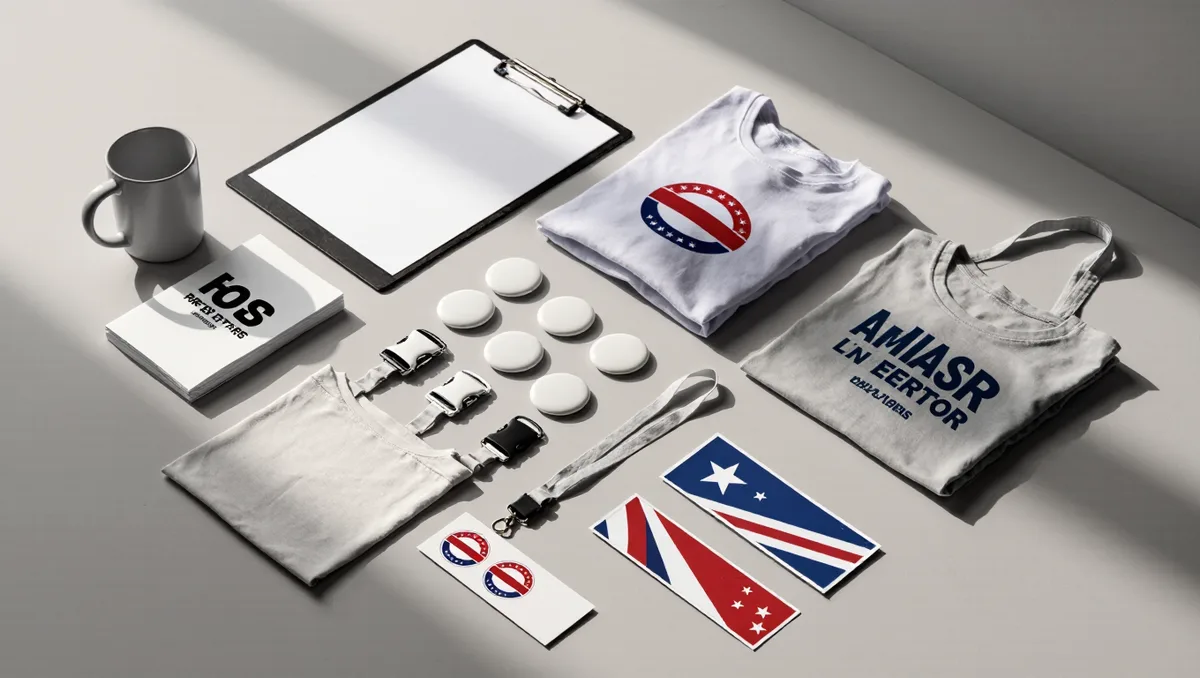
Political merch has moved from the campaign table to the permanent wardrobe. What was once a paper-thin souvenir tee, bought at a rally and retired by the weekend, now behaves like any other fashion segment: it has designers, drops, subcultures and a life between elections. The shift happened because the clothing stopped working only as a badge of allegiance and started working as a look.
The word itself explains part of the staying power. Merriam-Webster defines "political" as relating to government or party politics, but also as involving acts against a political system — a second meaning that matters here, because much of the apparel in this category speaks to movements as much as to parties. A shirt can carry a candidate's name or a cause's slogan, and both count. The category is broader than campaigns, and that breadth is what keeps it selling.
This sits close to the ground covered in How Protest Dressing Becomes A Uniform, where a movement's clothing hardens into a recognizable code. Political merch is that code with a price tag and a distribution chain. The tension worth watching is a real one: the same garment can be a sincere statement or an aesthetic borrowed from sincerity. Fashion has learned to sell both.
How did campaign apparel turn into fashion?
The short answer: the design got good, and the audience got younger. For decades, campaign apparel was designed to be legible from the back of a hall — blocky type, a flag palette, a name. It looked like advertising because it was advertising. The turn came when campaigns and movements began borrowing the visual language of streetwear: limited runs, better cotton, graphics that referenced concert merch and skate brands rather than yard signs.
Once the garment looked like something you would wear anyway, the political message rode along inside a normal outfit. That is the mechanism most trend watchers point to — not a sudden love of politics, but a merge of two wardrobes. A slogan tee stopped being a costume for a specific day and became an everyday layer. The same logic that turned band merchandise into mall fashion, covered in Why Music Subcultures Still Dress The Mainstream, applies almost line for line.
Who designs it, and who sells it?
Three production tiers now share the space. Campaigns and parties still print their own goods, usually through vendors who handle fulfillment and keep the operation legal and accounted for. Independent designers and small labels make the second tier: apparel built around causes, movements or slogans they support, sold like any other independent clothing line. The third tier is the fashion industry itself, where designers occasionally fold political graphics into runway collections or capsule releases.
Distribution matters as much as design. A campaign tee used to exist only where the campaign was. Online stores removed that limit, so a slogan can sell in cities the candidate never visits. Print-on-demand services lowered the cost of entry to nearly zero, which flooded the market but also let tiny movements dress their supporters within days. Speed, not scale, became the advantage.
Why does it outlast the election cycle?
Several forces keep the category alive between votes. The strongest is identity: for many wearers, political affiliation functions the way fandom does, and fandom apparel is worn year-round. A second force is the archive effect — older campaign items turn into collectibles, and the secondhand market gives them a second life as vintage. A third is the protest calendar. Movements do not follow election schedules, so movement-branded goods keep producing reasons to buy and wear.
There is also a quieter driver: irony and nostalgia. A decades-old slogan can be worn as a joke, a reference or a piece of graphic history, stripped of its original urgency. This is the same recycling pattern described in Why Nostalgia Runs On A Twenty Year Loop — yesterday's earnest statement becomes today's cool graphic. The meaning softens; the shirt keeps circulating.
What are the risks of wearing it?
The obvious one is social: in a polarized climate, the shirt is a public declaration, and wearers know it. The subtler risk is aesthetic rather than political. When a movement's symbol gets absorbed by mainstream fashion, the people who wore it sincerely often feel it was taken from them. That friction — between merch as belief and merch as style — is the genuine tension inside the category, and it has no clean resolution.
Buyers also face a provenance question. Not every shirt sold around a cause directs money to that cause. Independent printers, official campaign stores and opportunistic resellers can produce near-identical goods, and the garment itself rarely says which is which. Checking who prints and who profits has become part of buying political merch responsibly.
What this means for forecasting
For people who track style, political merch is now an input worth reading, not a novelty. Its graphics move fast, its audience is young, and its slogans are a real-time record of what a large slice of the public cares about. The category behaves like a pressure gauge: when a slogan spreads beyond its base and onto people who wear it as pure design, that is a signal the aesthetic has crossed over. The same crossover dynamics appear across the wider culture beat this site covers.
The durable takeaways are simple. Political merch earns a wardrobe slot when the design stands on its own, and it keeps that slot when the identity behind it stays active. Campaigns learned to design like fashion brands; fashion learned to borrow like campaigns. Neither side is giving the arrangement up.