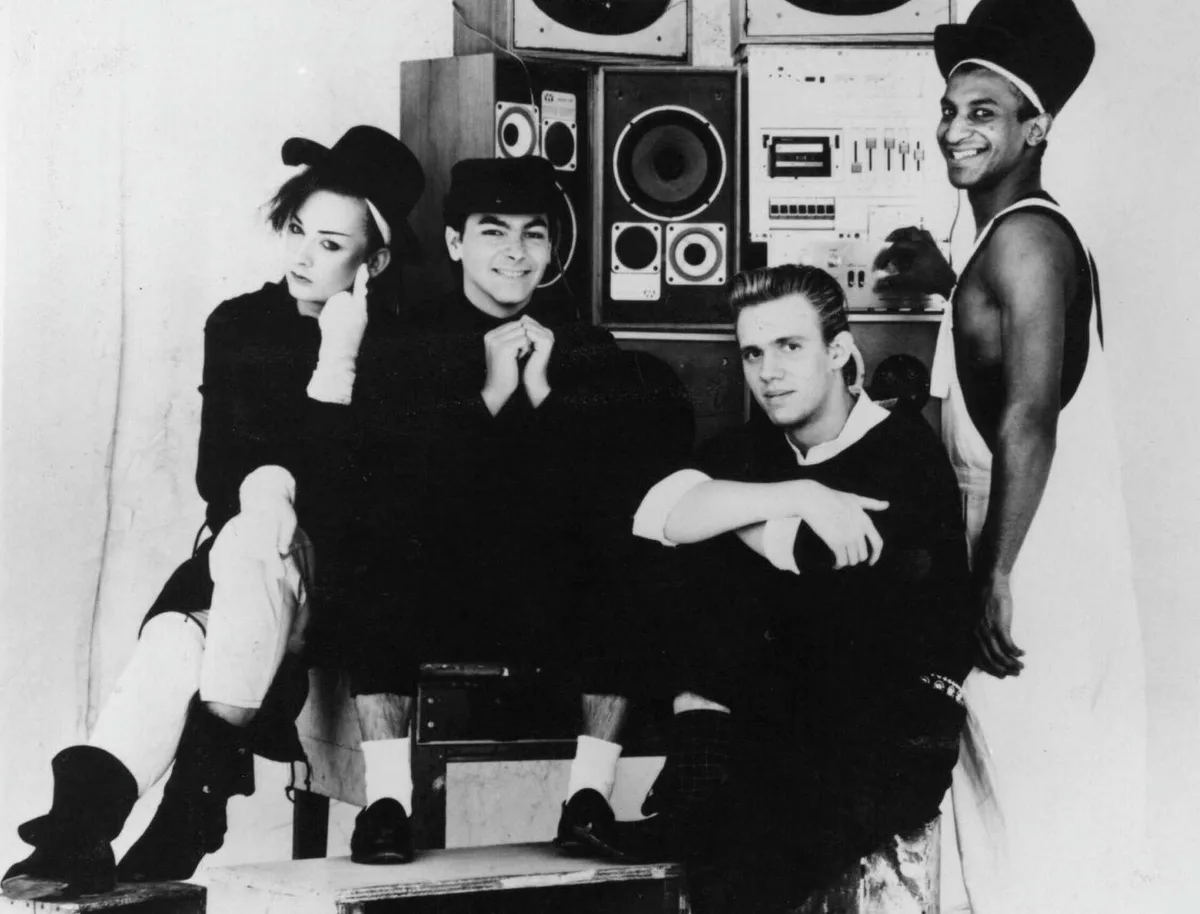
Culture Club endures because the band made clothing do the arguing. A singer in braids and a wide-brimmed hat, backed by musicians dressed like a traveling salon, turned the question of who wears what into a pop spectacle. The look was playful on the surface and pointed underneath: it said that style, not anatomy, decides what reads as masculine or feminine.
The appeal has lasted, in the plain sense of the word. Cambridge Dictionary defines "enduring" as long-lasting, continuing through time without significant alteration — and that is precisely what happened to the band's visual language. Each decade rediscovers it, and each decade finds something current in it.
What exactly did Culture Club wear — and why did it matter?
The signature elements are easy to list. Long braids threaded with ribbons. A hat, usually broad and brimmed, worn like a crown. Layered fabrics, bold color, jewelry that owed as much to grandmothers as to glam rock. Cheeks and lips made up openly, without apology or disguise. The overall effect was neither drag nor disguise; it was a third category, assembled from pieces the era assigned to different genders.
That mattered because of where it appeared. This was not a subculture performing in a basement club for an audience of initiates. It was a band on pop radio, on television, on tour posters on bedroom walls. The mainstream met the look in its most commercial, most cheerful form — a love song, not a lecture — and found it hard to dismiss.
The band's name itself did quiet work. Culture Club suggested that identity is something a group negotiates, a club anyone might join. Clothing was the membership card.
Where did the look come from?
Culture Club did not invent its aesthetic from nothing. It drew on the New Romantic scene that had been building in British clubs, on glam rock's earlier experiments with makeup and costume, and on a broader current of secondhand, cross-referenced dressing that ran through post-punk London. The point was never a single garment. It was the method: take pieces from anywhere — markets, army surplus, vintage racks, different decades and continents — and recombine them into a self that fit better than the one you were issued.
That method is why the style travels so well. A reader who wants the wider mechanics can see the same pattern in why music scenes always predict the next big aesthetic: the club floor tests the look, the pop stage broadcasts it, and the high street follows. Culture Club is a textbook case of that pipeline, with the broadcast stage doing unusually heavy lifting.
How did the style change pop identity?
The band's deeper contribution was to separate pop dressing from pop gender. Before this era, a male pop star who wore makeup was usually framed as either shocking or comic. The framing here was neither. The look was presented as glamour, with the confidence of someone who had simply decided the rules were optional — and audiences, particularly young ones, accepted the terms.
Once that door opened, it stayed open. Later pop stars could treat gender presentation as a palette to draw from rather than a fixed costume. The specific silhouettes changed with each generation, but the permission — the idea that a pop performer's wardrobe could make an argument about identity and still be mainstream entertainment — traces a straight line back to those braids and that hat.
The look was playful on the surface and pointed underneath: style, not anatomy, decides what reads as masculine or feminine.
There is a tension worth naming, because it is the genuine tension in the story. The band's image was celebrated as liberating, yet it was also a highly produced commercial package, managed as carefully as any pop product. Both things are true. The packaging does not cancel the effect; the effect does not purify the packaging. That double nature is part of why the look keeps being debated rather than filed away.
Why does the style keep coming back?
Nostalgia is the obvious engine, and it runs on a schedule — our own coverage of why nostalgia runs on a twenty-year loop explains the mechanism. But the Culture Club revival is not purely a loop. Each return happens in a different cultural weather, and the look picks up new meaning each time.
In a decade when gender presentation is a live public debate, a forty-year-old wardrobe of ribbons and hats reads differently than it did at the height of its first run. What was once read as eccentric is now read as an early argument in a conversation that has only grown louder. The clothes did not change; the audience did.
There is also a craft reason for the revival. The look is unusually teachable. Braids, a hat, layered color, a mix of hard and soft pieces — the formula is legible at a glance and adaptable at every price point. Styles that survive are styles that ordinary people can actually assemble, and this one assembles easily.
What this means for how trends travel
Culture Club's afterlife is a lesson in how a look outlives its moment. The sequence runs roughly like this:
- A subculture develops a dressing method that solves a real problem — in this case, how to present an identity the era had no tidy category for.
- A pop vehicle carries the method to a mass audience, stripped of its most confrontational edges but keeping its core argument.
- The mainstream absorbs the surface — the hat, the color — while the underlying idea, that dress codes are negotiable, seeps in more slowly and lasts longer.
- Later generations retrieve the look when their own arguments need it.
That fourth step is the one most coverage skips. The style returns not because the past is fashionable but because the argument it carried is unfinished. When a wardrobe encodes an idea rather than a silhouette, it becomes reusable equipment. Our explainer on why music subcultures still dress the mainstream makes the same point from the other direction: the mainstream is always wearing subcultural arguments it may not fully understand.
The practical takeaway for anyone watching fashion's direction: pay attention to which pop wardrobes are carrying an argument, not just a color. A season's palette is weather. A wardrobe that questions a rule is climate. The band understood the difference, dressed accordingly, and — in the durable, long-lasting sense of the word — the results have endured.
What remains unresolved
The evidence here establishes the look's components, its mainstream vehicle, and its recurring revivals. What no retrospective can settle is attribution: how much of the style's staying power belongs to the band's image, and how much to the wider scene that produced it. Both claims have honest adherents, and the honest answer is that the two cannot be fully separated. A band is also a scene's most visible output. That ambiguity, rather than any single verdict, is the truest thing this story leaves behind.