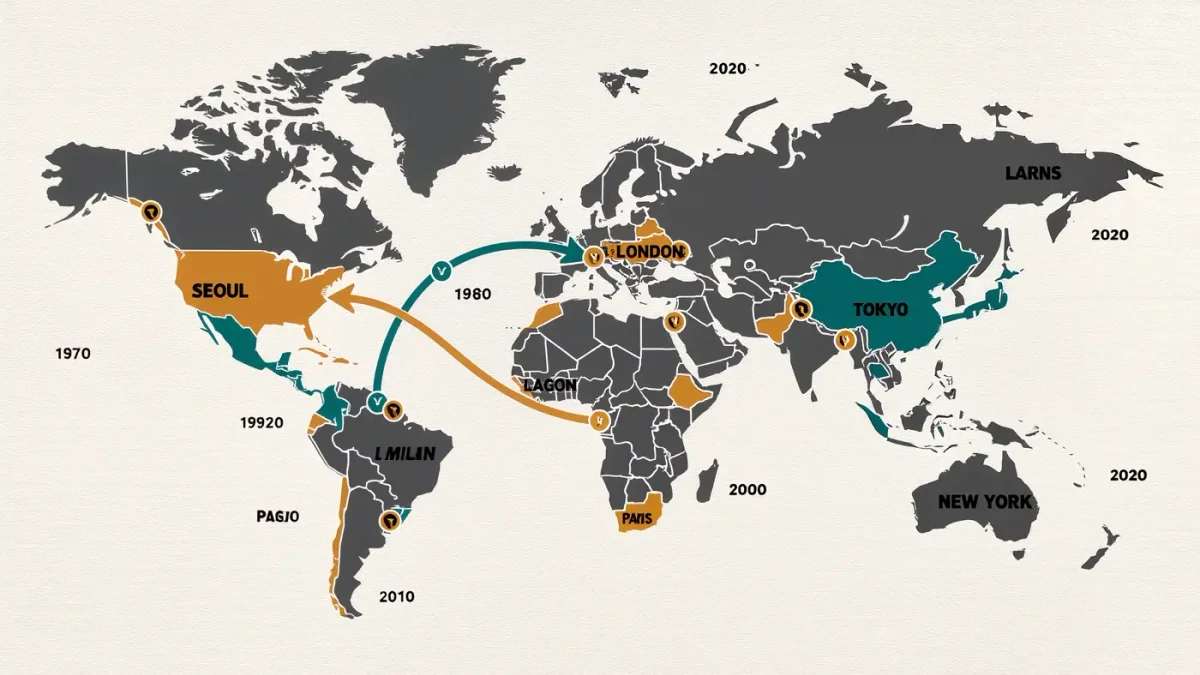
No single city exports style first anymore: the traditional four — Paris, Milan, London, New York — still export runway codes on the official calendar, but the street-level exports that forecasters prize now fire earliest in Seoul, Lagos, London and Tokyo, roughly six to eighteen months before their echoes reach the runway hubs. The shift is documented across the last two decades and it changed what trend agencies watch. Where a forecaster once bought a plane ticket to Paris, the same professional now tracks Seoul's neighborhoods and Lagos Fashion Week with equal seriousness.
Why Did Paris And Milan Lose The First-Mover Role?
They did not lose it so much as specialize it. The Big Four remain the export point for couture codes, luxury tailoring and the season's official narrative, because the runway calendar concentrates there and the buying appointments follow. But the official calendar is slow by design — collections shown in one season reach stores the next — while street-level style is exported through music, video and social platforms at platform speed. As trade analysts noted through the 2010s, the gap between an underground look and a runway citation narrowed from years to months, and the cities closest to the underground gained the first-mover role the capitals once held unchallenged.
Which Cities Fire First Today, And Since When?
- Seoul. Korean street style began its global export run in the early 2010s as K-pop's video economy carried Seoul silhouettes — oversized outerwear, precise layering, gender-fluid styling — to a worldwide audience; Seoul Fashion Week's growing trade relevance through the 2010s gave the city a formal stage to match its informal one.
- Lagos. Lagos Fashion Week, founded by Omoyemi Akerele in 2011, built an export pipeline for Nigerian tailoring, aso-ankara prints and a maximalist evening codes that international press and buyers began documenting in earnest by the late 2010s.
- London. The city's historical specialty is subculture: punk in the 1970s, grime's tracksuit-and-puffer codes in the 2000s and 2010s, each exported through music before appearing in luxury collections, a pattern London has repeated for five decades.
- Tokyo. Since the rise of Harajuku street culture in the 1980s and 1990s, and the global followings built by designers from Rei Kawakubo onward, Tokyo has exported mixture itself — the practice of combining vintage, technical and luxury pieces that mainstream wardrobes adopted a decade later.
How Do Forecasters Rank Export Cities?
Not by population or wealth, but by three documented properties: density of visible street style, speed from neighborhood to platform, and a music or screen culture that carries the look abroad. Agencies including WGSN and The Future Laboratory have run city-level scouting for exactly these signals, treating a district the way an analyst treats a stock — tracked for early movement. The rankings shift with the culture Seoul's ascent in the 2010s followed K-pop's global breakout, just as London's Punk-era prominence followed its music press. A city keeps first-mover status only while its subcultures keep producing looks the mainstream has not yet metabolized.
What Role Does Music Play In The Export?
Music is the carrier wave, and every first-mover city on the map has one. Seoul's export ran on K-pop's video economy; London's ran on punk, jungle and grime; Tokyo's on the street-culture press built around hip-hop and club scenes; Lagos's rode Afrobeats from regional charts to global streaming prominence through the late 2010s — a rise documented when Nigerian artists began collecting major international nominations and awards from 2020 onward. The mechanism is consistent: fans adopt the wardrobe of a scene before they adopt its sound, music video and touring photography circulate the looks at platform speed, and by the time luxury brands cite the silhouette, the source city has already moved to the next one. A city without a live music export rarely holds first-mover status for long.
Can A New City Join The First Movers?
Yes, and history shows the entry requirements. Kingston supplied dancehall's wardrobe to international fashion repeatedly from the 1980s through the 2000s; Mexico City, Johannesburg and Ho Chi Minh City appear in forecaster city reports as watch-list hubs with growing street-style documentation. The gate is infrastructure rather than talent: a fashion week or trade platform that formalizes exports, a resale or social layer that documents the street, and a music or screen culture with international reach. When those align — as Lagos demonstrated after 2011 and Seoul after the early 2010s — a regional scene can move to first-mover status within a decade, which is why agencies keep rotating their scouting map rather than fixing it.
Why Does Timing Differ Between Hubs?
Because each export runs on its own clock. Runway hubs operate on the official calendar, roughly six months from show to store; music-driven hubs export at release-cycle speed, a matter of weeks from video drop to global screenshot; and resale platforms export instantly, the moment a garment is photographed and listed. Forecaster practice is to read the three clocks against one another: when a silhouette appears in Seoul street photography and on resale within one quarter, its runway citation is usually two seasons out. The cities that matter most are the ones where those clocks run closest together, because that is where the lag between origin and confirmation is shortest.
What Does The Export Map Look Like Now?
Layered. The runway capitals export the official season; Seoul and Tokyo export styling logic; Lagos exports craft and color codes; and regional hubs add local variants that surface on resale platforms before any institution notices. By the mid-2020s trade coverage described a genuinely parallel system, where a look could originate in a Lagos atelier or a Seoul neighborhood and appear in Paris as a citation rather than an origin. For the reader, the practical takeaway is directional: when a silhouette starts appearing across two of these exporting cities at once, the runway revival is usually six months behind — and the street had it first.