How does a style born on one street in Seoul, Lagos or Los Angeles end up in stores everywhere? The short answer: it moves through stages. A look starts as a local habit, gets noticed, gets named, gets copied, and finally gets manufactured at scale. Each step takes a different kind of messenger — a photographer, a forecaster, a buyer, a factory.
That sequence matters to readers because it separates a durable trend from a two-week spike. A look that has already passed through several stages has staying power. A look that only exists on one platform's feed usually does not. This explainer walks through the stages, using plain language and no forecasts of our own — the site reports on forecasts, it does not issue them.
What does "local" actually mean before a trend travels?
It helps to start with the word itself. A dictionary entry for "local" covers ground: local color, local culture, local product, local knowledge — the vocabulary of a place and the people who live in it. The New Oriental online dictionary lists "local color" and "local culture" among the word's most common pairings, which says something. When people talk about a local trend, they mean a style tied to one community's habits, climate, economy and history.
That rootedness is the raw material. A Lagos tailor cutting a specific sleeve shape, a Seoul vintage dealer restyling a jacket, an LA skater wearing one brand of work pant — none of it starts as a trend. It starts as a solution to a local problem. Heat, modesty, work, rent, transport. The style spreads locally because the problem is shared.
The English-language dictionary record makes the same point from another angle. Usage examples collected by iCiba show "local" attached to markets, customs, tastes and economies — the local market, the local economy, adapting to local tastes. A local trend is, in that sense, a local economy of taste: makers, wearers and buyers in one small loop.
How does a look get noticed outside its neighborhood?
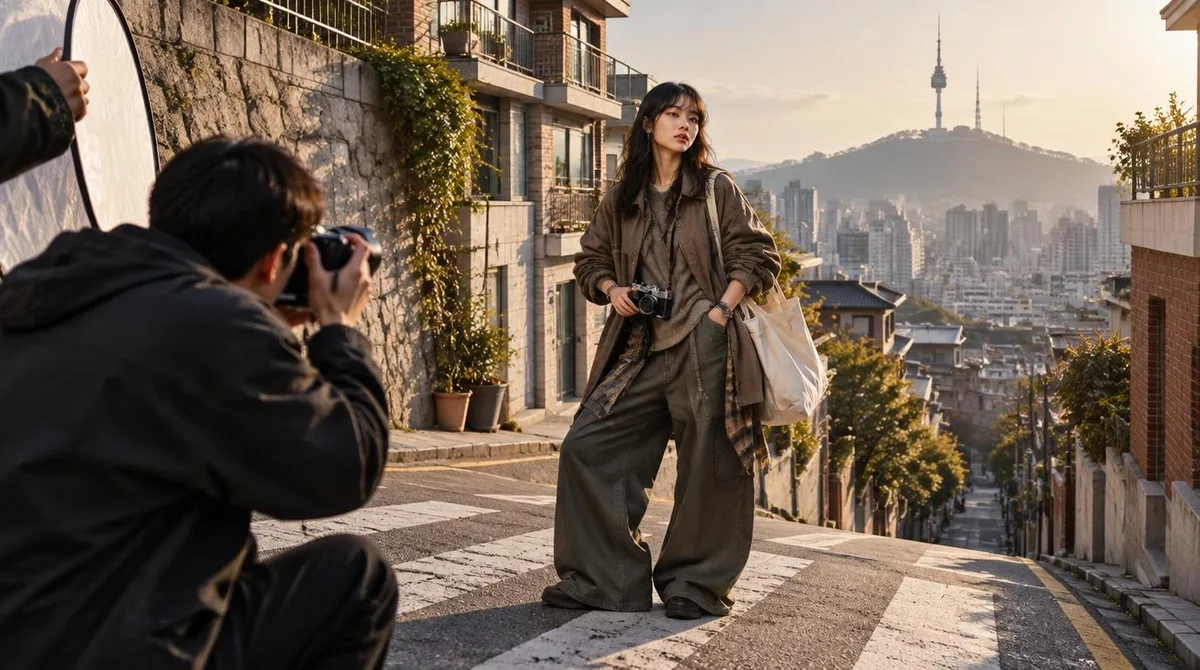
The first jump is usually made by an outsider's eye. Street-style photographers, visiting stylists, music-video crews and tourists all photograph what looks fresh to them precisely because it differs from home. The look that reads as ordinary on its own street reads as signal somewhere else.
Platforms compress this stage. A clip shot on one block can be seen on three continents in a day, which is why the timing of the "discovery" stage has shortened. But compression does not change the mechanism: someone outside the community has to see the look as worth copying. Our piece on what trending actually measures explains why an algorithm's attention is not the same as cultural weight — Trending Algorithms: What "Trending" Actually Measures, and Who Gets to Decide covers that gap in detail. For related coverage, see Trending Algorithms: What "Trending" Actually Measures, and Who Gets to Decide.
What this means for readers: the moment a look gets noticed is the moment it starts to change. Worn for a local reason, it is now worn as a reference. The reason can drop out entirely.
Who names a trend, and why does naming matter?
A trend becomes official when it gets a name. Naming is the job of forecasting agencies, editors and retailers, and it is more powerful than it sounds. A name turns a scattered set of looks into a category that buyers can order against and writers can cover. Coverage on this site follows that logic closely — see Why WGSN Flagged Dubai Chocolate Five Years Before It Went Viral, a documented case of a forecaster tracking a regional product long before general attention arrived. This connects to our earlier piece, Why WGSN Flagged Dubai Chocolate Five Years Before It Went Viral.
Naming also carries risk. A name can flatten a local style, stripping the context that made it work. A garment cut for one community's body, climate or budget gets reissued without those reasons. That is the honest cost of the global stage, and it is why serious coverage keeps the origin attached to the name.
How does retail scale a local look?
Once a look is named, buyers translate it into orders. This is the least glamorous stage and the most decisive. A buyer decides how many units, at what price, in which sizes, for which stores. If the order is large, the look reaches the high street. If the order is cautious, it stays a niche signal.
Scale changes the garment. Local versions are often made in small runs, adjusted by hand, sold by the person who made them. Global versions are graded by machine, priced for volume, and cut from cheaper cloth to hit a price point. The silhouette can survive; the feel often does not. Readers who care about the difference can look at construction details — seam finishing, fabric weight, hem allowance — before assuming the store version carries the same quality as the street version.
Our analysis: the retail stage is where a local trend either becomes a global one or quietly stalls. Most stall. The ones that scale tend to be the ones that solve a problem many places share, not just one.
What can a reader do with the stages?
Practical steps, in order. First, ask where a look came from and what problem it solved. Second, check whether it has been named by a forecaster or an editor — that tells you how far along the path it is. Third, watch the retail stage: if it appears in a buyer's order book or a store's new arrivals, it has crossed from signal to product. Fourth, decide for yourself whether the scaled version still serves you. Fit is a skill, not a body type, and a global trend is only useful if it fits your actual wardrobe and budget.
One caution. The stages are a map, not a clock. There is no fixed time from street to store, and no stage guarantees the next one. Anyone selling certainty about a trend's arrival is selling something the evidence cannot support.
The takeaway: local is the source, global is the edit
Every global trend was local first, and the local version usually carried more information than the global one. The path — habit, notice, name, scale — repeats across cities and decades. Knowing the path lets you read trend news with a question in mind: which stage is this story actually about? That question, more than any single forecast, is what keeps a reader ahead of the rack.