Quiet luxury is fashion's understated aesthetic: clothes and accessories that signal wealth and taste through fabric, cut and color rather than logos. The look runs on rich neutral tones, clean silhouettes and minimal visible branding. Its core test is simple — the piece should read as expensive up close, not from across the street.
The style has moved from a niche preference to one of fashion's defining directions, and it keeps showing up on the most-watched wardrobes in the world. A recent example: the Duchess of Sussex carried a woven leather Joseph handbag in espresso on a visit to Nottingham, a piece Yahoo Entertainment described as reflecting the quiet luxury trend, with minimal visible branding and a classic design. The bag, listed at $1,105 on Joseph's U.S. site, did the work a logo usually does — quietly.
So what is quiet luxury, exactly, and why has it lasted longer than most viral aesthetics? The short answer: it borrows the visual language of old money — restraint, texture, tailoring — and it survives because it flatters the wearer rather than the brand.
What does quiet luxury actually mean?
At its core, quiet luxury is a value system about where the visible effort goes. Instead of a monogrammed canvas or a chest-height logo, the money sits in the things you feel: the weight of the leather, the drape of a cashmere coat, the precision of a shoulder line. As the Yahoo report on Meghan Markle's Nottingham outfit put it, the aesthetic emphasizes understated pieces rather than attention-grabbing logos. This connects to our earlier piece, The Quiet Luxury Brands Defining Understated Style Right Now.
Three hallmarks come up again and again. First, a muted palette — browns, creams, camel, burgundy, deep greens. Second, texture over print: woven leather, brushed wool, ribbed knits. Third, structure: bags and coats hold a shape, because shape reads as craft.
The inverse matters too. Quiet luxury is not the same as minimalism. A minimalist wardrobe can be cheap; a quiet-luxury one is not pretending to be. The point is not the absence of design but the absence of advertising.
Where did the aesthetic come from?
The look has long roots in the wardrobes of European aristocracy and old-money American style, where visible branding was itself considered vulgar. What changed recently is how the wider industry adopted that posture. After years of logo-heavy collections dominating the luxury market, the pendulum swung toward discretion — a shift visible across runways, retail floors and celebrity dressing rooms. For related coverage, see The Autumn 2026 Fashion Calendar Tightens, and the Schedule Itself Became the Story.
Celebrity context did much of the accelerating work. The wardrobes of royal-adjacent figures became reference points precisely because they avoid trend-chasing. The Princess of Wales is frequently described as favoring structured handbags, classic silhouettes and polished accessories that complement an outfit without overwhelming it — a template the current aesthetic maps onto almost exactly.
Our analysis: quiet luxury endures because it solves a status problem. A logo announces that you bought a brand. A perfectly cut coat in mahogany wool announces that you know what a good coat is. The second signal is harder to fake, which is exactly why it carries more value.
What do the hallmark pieces look like?
The Nottingham look breaks the formula down neatly. Meghan Markle paired a brown Joseph high-neck jumper with a plum pencil skirt from The Fold London, a dark tan leather belt from Marks & Spencer and burgundy Jennifer Chamandi pumps, layered under a Joseph wool-cashmere coat in mahogany. According to Yahoo Entertainment, she mixed shades of brown, plum and burgundy rather than wearing a single color head to toe — a tonal approach that has become the aesthetic's signature styling move.
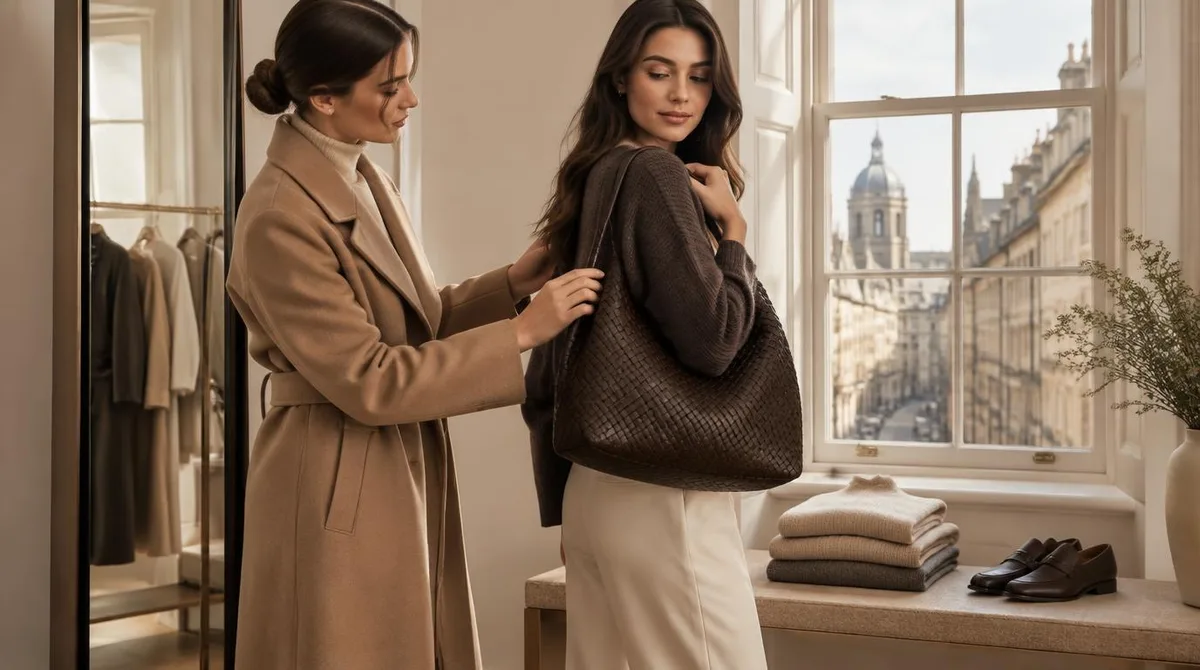
The accessories follow the same logic. Her Joseph Mini Loaf bag is made in Italy, with supple leather in an embossed woven-effect finish, a gold-tone zipper pull and protective base studs. The woven texture adds visual interest without a bold logo or bright color, and the compact silhouette carries everyday essentials without bulk.
For anyone reading this as a shopping brief, the transferable ideas cost nothing: a chocolate-brown knit over burgundy trousers, a structured bag in a dark leather, texture where a print would go. The colors and silhouettes can be recreated at lower price points, as the reporting itself notes — the aesthetic is a styling system before it is a price tag.
Why celebrities keep dressing this way
Quiet luxury is the ideal celebrity wardrobe for a specific reason: it photographs as expensive without reading as an advert. A logo bag turns a paparazzi shot into a campaign. A woven espresso tote turns it into a style story.
It also lets public figures mix price points without looking inconsistent. The same Yahoo report notes that Markle has carried a Chanel handbag valued at more than $9,000 on another occasion, alongside an ensemble estimated at roughly $37,000 — and that the $1,105 Joseph bag represents a lower-priced addition to a wardrobe that spans designer tiers. Mixing high and higher, all in the same restrained register, is part of the point. The aesthetic absorbs price variation without breaking character.
There is a cultural reading here too. The style traces back to a subculture of discretion — royal and aristocratic dressing codes — and what feels new is not the codes themselves but their adoption as a mass-market direction. What feels recycled is the old-money fantasy; what feels new is that social media, which once rewarded maximal logo visibility, now rewards legibility of taste.
What this means for the rest of the wardrobe
For the industry, quiet luxury changes what a brand has to sell. Without a logo, the product has to justify itself on quality — which raises the stakes on fabric sourcing, manufacturing and aftercare. For shoppers, it rewards a slower kind of buying: fewer pieces, better made, in colors that pair with each other for years.
The look also travels well across budgets, which is rare for a luxury trend. Because the signal lives in palette, texture and fit, a high-street version can land close to the designer original. That accessibility is part of why the aesthetic has outlived the moment that named it.
What the evidence establishes is a durable definition and a working formula: muted tonal palettes, textured materials, structured silhouettes and near-invisible branding. What remains open is how long the current appetite for discretion holds — fashion's pendulum has swung back toward logos before, and no aesthetic keeps the floor forever.